Lemur (Prosimians/Strepsirhini):
1. Lemurs are strepsirhini primates that habitat in the wild of the old world. Lemurs at a certain time lived in most tropical region of the earth including North America. Lemurs now are mostly seen in the islands Madagascar and comoro island.
2. The lemurs dentition pattern is Heterodont, which means the lemur possesses more than a single tooth morphology. Their dental formula is
2.1.3.3 (top) 2.1.3.3 bottom, which consists of 2 incisors, 1 canine, 3 premolars, and 3 premolars for both ( top and bottom). Lemurs posses toothcomb teeth, the bottom incisor and canine teeth are faced forward rather than up
and spaced wide enough for them to groom or eat. For instance, some lemurs use their toothcomb to induce the tree slap by removing the bark. Its pretty amazing how lemurs keep their toothcombs clean. The toothcombs stay clean by a specialized structure that is located in their sublingual that imitates the functions of a toothbrush to remove residue of food or hair from when grooming.
3. Lemurs are known to be herbivores since they abide on tree tops making fruits and leaves available. The environment they reside lets them multiple due to the abundance of food.

Spider Monkey (New World Monkey/Platyrrhini)
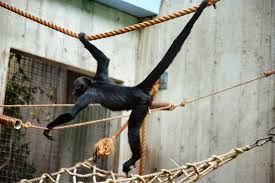
1. Spider Monkeys can be found in South America and Central America, similar to lemurs. Spider Monkeys spend most their days on top of trees far away form predators. Their body structure of long arms and flexible body it gives them a chance to swing from one tree to another.
2. THe Spider monkeys dentition pattern is 2.1.3.3 (top) 2.1.3.3 bottom, which consists of 2 incisors, 1 canine, 3 premolars, and 3 premolars for both ( top and bottom). They eat fruits, nuts, insects, flowers, bird eggs, spiders, and small mammals (whoa).
3. Spider Monkeys adapted to their environment, for instance there incisors that are used specifically to pick of fruits off the trees.
Baboons (Old World Monkey) :
1. Baboons abide ethiopia, saudi Arabia, and Yemen. Baboons have demonstrated that they are capable of surviving in different terrains, for instance savannas, tropical forests and semi-arid climates.
2. Baboons dental formula is 2.1.2.3 (top) 2.1.2.3 (bottom), which means 2 incisors, 1 canine, 2 pre-molars and 3 molars. The males can have canine teeth as long as 2 inches
3. Baboons eat fish small animals and leaves, pretty healthy diet. Their dentition allows them to be omnivorous, therefore able to survive in different terrains.

Gibbon (Lesser ape):
1. Gibbons abide in in southeast Asia, and parts of Southern China, in tropical and sub tropical rain forest. You will always see them on trees swinging like the spider monkeys. They can airborne in distance of up to 15 meters and at speeds as much as 56 km/h.
2. Their dental formula is 2.1.2.3 (Top) 2.1.2.3 (bottom), 2 Incisors, 1 canine, 2 pre-molars, and 3 molar. The teeth are similar to the great apes.
3. Gibbons are known to prefer eating fruits, which just so happens to be everywhere in their environment, therefore there dentition would have had to adapt to the environment in oder to eat their food.

Chimpanzee (Great ape/Hominidae)
1. Chimpanzee's can be found in Africa in rain forests and savannas.
2. Their dental formula is the dame as Gibbons and Baboons, 2.1.2.3 (top) 2.1.2.3 (bottom), which means 2 incisors, 1 canine, 2 pre-molars and 3 molars.
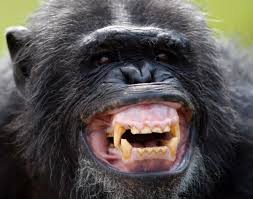
3. Chimpanzees dentition allows them to adapt into eating about almost everything from plants, to small animals.
4. After learning about these different primates dentition patter, we can draw to a close that the environment and type of food consumed makes a difference in dental structure. An example of this would be the similarities between spider monkeys and lemurs they both have the same dental formula, as well as the same environment, which would make them New world Monkey. They live in similar environment and have the same diet of fruit and leaves which explains the similarities between the two. The Baboon, Chimpanzee, and Gibbon has a similar dentition pattern, which would make all three old world monkey. Their dentition allows them to adapt to different environment for it allows them to basically eat anything.
