Thursday, April 2, 2015

    High level altitude can affect the survival of humans in a bad way, due to the high altutude's air pressure is about 30 percent lower because of the atmosphere is less dense. Which mean that the air molecules are farther apart. Hypoxia or oxygen deprivation is the result of being exposed to high altitude dud to the air pressure is lower it makes it more difficult to allow oxygen to enter our vascular systems. The effects of the Hypoxia on  a human body are, lack of physical activities, appetite, distorted vision, and difficulty with memorizing and thinking coherent. Our bodies are very sensitive, for if your not able to adequately adjust to the new altitudes your body might warn you by developing some symptoms warning you to go back to sea level.

Acclimatizing occurs to our body when it needs to adapt to high altitudes. Acclimatizing is where our bodies produce more red blood cells and capillaries to carry more oxygen. Due to this processour lungs tend to grow in oder to allow the osmosis of oxygen and carbon dioxide.
Image result for blood cells production


A facultative adaptation that our bodies do when going into higher altitudes is producing more hemoglobin to carry oxygen throughout our bodies. In order to do this you would need to take an IRON vitamin. Iron produces hemoglobin. In doing this you are helping your body acclimate to high altitudes by not stressing the body to much to produce more blood cells and capillaries to carry the oxygen.

They're humans that develop through genetics the ability to withstand high altitudes better than others. for instance the indians in the high mountains of peru and bloivia are known to be able to produce more hemoglobin in their blood and increase their lung expansion, but they are not the only ones. Alot of people around the world have been able to adapt to certain altitudes though they are some castrophe leading to death. 

Tuesday, March 24, 2015

Langauge Post

1. For this experiment I tired to communicate with my roommate without using hand or verbal language, which was quite difficult. The reason I felt this task to be difficult is because we are accustomed to using our hands when we speak, we tend to use them to emphasize our point.  When trying the experiment my partner answered his questions by making strange facial expressions to get his point across. I tried to use my eyes, which at one point I felt as if they were popping out; my roommate and friends were amused and weird out.  After this experiment I notice how dull a conversation would be if not for verbal or hand expressions. If it came down to two different cultures, I feel the most advanced in terms of communication would advance. For proper communication would lead to better strategies for hunting, war and being able to form a complex society. I feel as if in our culture the people who are deaf might have a hard time communicating with others that don’t understand sign language. The thought of isolation from the world would come to mind.


2. I wasn’t able to last the whole 15 minutes, but my roommate managed to only use verbal communication. For me it was hard for I’m a person that expresses himself with hand and verbal communication. The way my roommate managed to not use his hands was because he had placed them in his pocket, so when he had the urge to use his hands he couldn’t. The limitation I had made my conversation seem dull as if I didn’t have emotions, for our gestures, hand movement are a part of which we are and with them we express ourselves how we want.


Reading body language can be a bit difficult. For everyone is different and cant really determines a person’s mood or interests thru body language. An example of the benefits of being able to read body language is for instance: you’re with a group of friends and want to have a moment alone with only one friend, what you can do is move your eyes to the direction where you want to go meet them alone.

Thursday, March 5, 2015

Comparative Primate

Lemur (Prosimians/Strepsirhini): 
1.  Lemurs are strepsirhini primates that habitat in the wild of the old world. Lemurs at a certain time lived in most tropical region of the earth including North America. Lemurs now are mostly seen in the islands Madagascar and comoro island.
2. The lemurs dentition pattern is Heterodont, which means the lemur possesses more than a single tooth morphology. Their dental formula is 2.1.3.3 (top) 2.1.3.3 bottom, which consists of 2 incisors, 1 canine, 3 premolars, and 3 premolars for both ( top and bottom). Lemurs posses toothcomb teeth, the bottom incisor and canine teeth are faced forward rather than up and spaced wide enough for them to groom or eat. For instance, some lemurs use their toothcomb to induce the tree slap by removing the bark. Its pretty amazing how lemurs keep their toothcombs clean. The toothcombs stay clean by a specialized structure that is located in their sublingual that imitates the functions of a toothbrush to remove residue of food or hair from when grooming. 
3.  Lemurs are known to be herbivores since they abide on tree tops making fruits and leaves available. The environment they reside lets them multiple due to the abundance of food. 


Image result for lemurs


Spider Monkey (New World Monkey/Platyrrhini)

1. Spider Monkeys can be found in South America and Central America, similar to lemurs. Spider Monkeys spend most their days on top of trees far away form predators. Their body structure of long arms and flexible body it gives them a chance to swing from one tree to another. 
2. THe Spider monkeys dentition pattern is 2.1.3.3 (top) 2.1.3.3 bottom, which consists of 2 incisors, 1 canine, 3 premolars, and 3 premolars for both ( top and bottom). They eat fruits, nuts, insects, flowers, bird eggs, spiders, and small mammals (whoa). 
3. Spider Monkeys adapted to their environment, for instance there incisors that are used specifically to pick of fruits off the trees. 
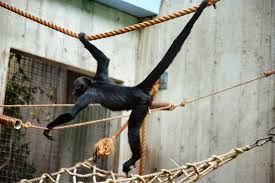
Image result for spider monkey

Baboons (Old World Monkey) :
1. Baboons abide ethiopia, saudi Arabia, and Yemen. Baboons have demonstrated that they are capable of surviving in different terrains, for instance savannas, tropical forests and semi-arid climates.
2. Baboons dental formula is 2.1.2.3 (top) 2.1.2.3 (bottom), which means 2 incisors, 1 canine, 2 pre-molars and 3 molars. The males can have canine teeth as long as 2 inches
3. Baboons eat fish small animals and leaves, pretty healthy diet. Their dentition allows them to be omnivorous, therefore able to survive in different terrains.

Gibbon (Lesser ape):
1. Gibbons abide in in southeast Asia, and parts of Southern China, in tropical and sub tropical rain forest. You will always see them on trees swinging like the spider monkeys. They can airborne in distance of up to 15 meters and at speeds as much as 56 km/h.
2. Their dental formula is 2.1.2.3 (Top) 2.1.2.3 (bottom), 2 Incisors, 1 canine, 2 pre-molars, and 3 molar. The teeth are similar to the great apes.
3. Gibbons are known to prefer eating fruits, which just so happens to be everywhere in their environment, therefore there dentition would have had to adapt to the environment in oder to eat their food.


Chimpanzee (Great ape/Hominidae)
1. Chimpanzee's can be found in Africa in rain forests and savannas.

2. Their dental formula is the dame as Gibbons and Baboons,  2.1.2.3 (top) 2.1.2.3 (bottom), which means 2 incisors, 1 canine, 2 pre-molars and 3 molars.
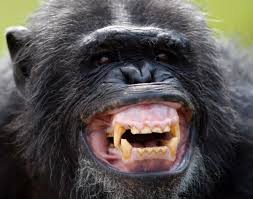
Image result for chimpanzee3. Chimpanzees dentition allows them to adapt into eating about almost everything from plants, to small animals.


4. After learning about these different primates dentition patter, we can draw to a close that the environment and type of food consumed makes a difference in dental structure. An example of this would be the similarities between spider monkeys and lemurs they both have the same dental formula, as well as the same environment, which would make them New world Monkey. They live in similar environment and have the same diet of fruit and leaves which explains the similarities between the two. The Baboon, Chimpanzee, and Gibbon has a similar dentition pattern, which would make all three old world monkey. Their dentition allows them to adapt to different environment for it allows them to basically eat anything.


Thursday, February 26, 2015

Homologous and Analogous


Image result for human

Image result for the blue whale


1. The two different species I chose that had common Homologous traits, are humans arm and the flipper of a whale.  
     
     Some Homologous traits between the two would be the Humerus and neck bone (seven). A giant whale has the very same amount of neck bones as humans (seven). Another commonality is the large upper arm bone in the whale, which would be the humerus in humans. Much of their differences in their anatomy are due to divergent evolution. 

   They came from a common ancestor, placental mammals, named for the placenta that nourishes the fetus during development. 


 Image result for insects eyesImage result for human eye
2. The Two different species that had similar Analogous traits are humans and an insect. 

The analogous trait that they have in common is their eyes. They both have lenses and light sensitive cells that help their eyes to collect data that a brain can form into an image of their surroundings. The difference would be a human just has one single large lens per eye, as for an insect compound eye have many tiny lenses with one lens per ommatidium.  


They're no common ancestors between humans and insects, due to convergent evolution, which makes it impossible for these two to have common ancestors. 

Thursday, February 19, 2015

Thursday, February 12, 2015

Influence on Darwin

I would have to say that Alfred Russel Wallace who had the most influence on darwin on natural selection. The Contribution that wallace made to the science community took place when he ventured to the amazon river. With the opportunity of having unique and vast amount of plant and animals wallace discovered unique traits of certain animals and plants. Some of the traits the animals presented were the ability to camouflage when preditors are near and plants that had variety of mechanisims to fight off insects.

"If the environment changes, the traits that are helpful or adaptive to that environment will be different". This point affected Alfred wallaces work. For when looked at the wallace effect and how it notices certain species of plants and animals correlate into their enviorments and avoid to mate hybridly to avoid the sure higher reproduction rate.

With both of them venturing the world, Darwin more than wallace its said that they both developed the theory of natural selection, which would later be joined. But wallace had a big influence on darwin, for if not for wallace sharing his work with darwin, he would of never had published it.

The additude of the church affected him amd his release of his book, due to the anger and contraversy it would of caused towards the theory of evolution. THe church being a holy place that believes in the bible and gods word and oly his, viewed darwin and his theories to be naive. The discouragment of the church towards darwin despaired him, but with the gradual help of wallace, darwin released his book regardless of what other thought.

Thursday, February 5, 2015

My two Items

If stranded in a desert island with only two items to survive i would have to choose a fire starter and a tent. The tent for refuge and a fire starer to create warmth and to be able to cook food.